EVENT RECAP
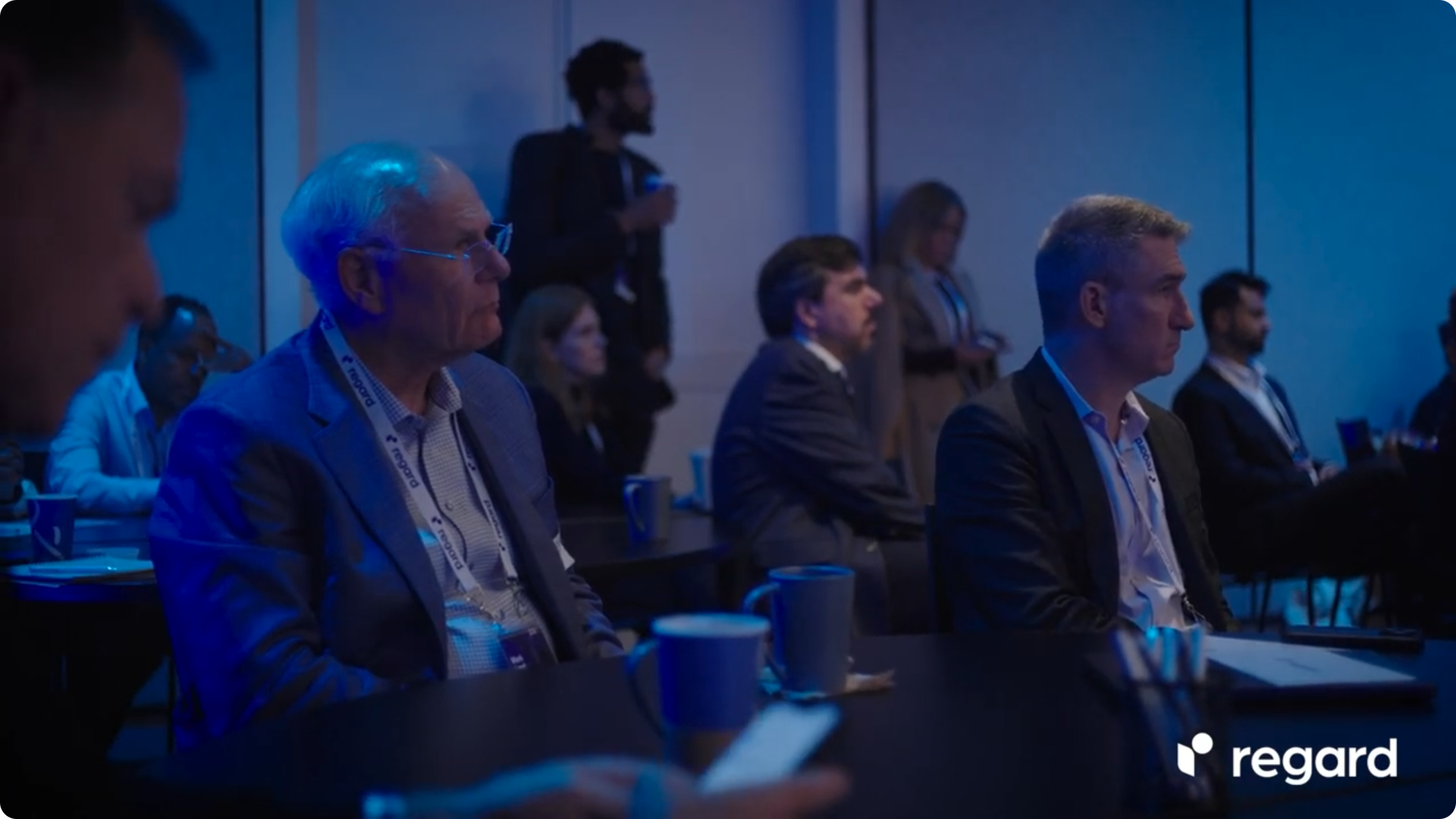

Leaders, clinicians, and innovators focused on the impact of AI on patient care, today and into the future.
Sessions & Highlights
Watch the recapAt the 2025 Regard Summit, healthcare and technology leaders explored how AI is reshaping care and innovation.
Through keynotes, panels, and hands-on sessions, speakers shared real-world case studies and forward-looking insights on building smarter and more human-centered healthcare workflows and systems.
KEYNOTE
Inevitable futures
Speaker: Eli Ben-Joseph (CEO, Regard)
Regard CEO Eli Ben-Joseph opened the summit with a powerful look at the past, present, and future of medicine, exploring how the exponential growth of data has both transformed and burdened healthcare. Tracing a century of progress from the doctor’s black bag to the digital record, he illustrated how today’s clinicians face a data overload that leaves 97% of patient information unseen. Eli outlined Regard’s vision for a new “golden era” of medicine, one where technology amplifies physician wisdom by leveraging data rather than competing with it, enabling every patient to receive the best possible care through truly proactive documentation.
 Key Takeaways
 Share this Session
The new standard for clinical documentation
PANEL
From reactive to proactive: Changing the care and documentation paradigm
Speakers: Dr. Patrick Woodard (Chief Information Officer, Monument Health), Dr. Samantha Flynn (System Medical Director of Utilization Management, Main Line Health), and Dr. Rollin Reeder (Associate CMIO, Sentara Health)
Moderator: Nate Wilson (Co-Founder & President, Regard)
Moderated by Regard co-founder Nate Wilson, this panel explored how “Proactive Documentation” is redefining collaboration between clinicians and administrative teams. Health-system leaders discussed the shift from reactive note-taking to AI-driven workflows that capture complete documentation upfront and ease physician burden. They shared candid insights on burnout, query fatigue, and the challenges of manual coding—alongside early results from Regard deployments showing higher accuracy, fewer denials, and happier clinicians. The message was clear: the shift to proactive workflows is already transforming both financial and clinical outcomes.

We may finally be going toward a world where the EMR is just a database again and clinicians can have true autonomy in their work.

By having the data at the time you want it, you make sure the patient gets the care they want — and ultimately, a better life.

Regard is essentially a second pair of eyes looking after your patient.

Knowing that Regard will pick up certain diagnoses lets me focus on the primary problem. I’m less stressed about the documentation and get more face time with my patients.

Regard improved cognitive load for our physicians, and strengthened our focus on patient safety by surfacing critical clinical insights.
We enhanced our financial performance and empowered our clinicians with the AI tool to make sure that they’re able to make intuitive decisions.

There is no dearth of innovative ideas. There's no dearth of use cases. It's the “how” do you create that ecosystem that works for the provider organization, that works for the early stage firms to take that concept or that idea into reality, in the amount of time that makes sense for everyone.

We've curated this group of people to build a community around a shared belief that a better way to do healthcare is possible.

Turning innovation into impact
PANEL
AI in healthcare: Promise, progress and practicality
Speakers: Tarun Mehra (Microsoft Cloud + AI) and Eli Ben-Joseph (Regard)
Moderator: Bobby Guelich (Elion)
Microsoft’s Tarun Mehra and Regard CEO Eli Ben-Joseph discussed how AI is transforming healthcare—from ambient documentation to clinical decision support—while emphasizing responsible innovation, strong governance, and trusted data. They urged health systems to balance safety with speed, pilot quickly, and keep a startup mindset. Both agreed that AI should enhance, not replace, human judgment and empathy in care.
PANEL
Making it real: Operationalizing innovation in the hospital
Speakers: Dr. Mary Weitzel (FirstHealth of the Carolinas) and Dr. Renee Allenbaugh (Penn Highlands Healthcare)
Moderator: Lindsi London (Regard)
Dr. Mary Weitzel and Dr. Renee Allenbaugh shared how hospitals can bring AI into everyday clinical practice by engaging stakeholders early, addressing physician pain points, and fostering trust. They discussed how thoughtful rollout and peer leadership can turn skepticism into advocacy, leading to stronger documentation, happier clinicians, and lasting cultural change.
Insights in action
PANEL
Proof in practice: The ROI of proactive documentation
Speakers: Shameka Hooks (WakeMed Health & Hospitals) and Dr. Matthew Shafiroff (White Plains Hospital)
Moderator: Ross Moore (Regard)
This session highlighted how Regard is transforming both performance and care through smarter documentation. At WakeMed, Shameka Hooks shared how the platform drove a 10% CMI lift, $4.4M in projected annual revenue, and measurable gains in quality metrics. Dr. Matthew Shafiroff described how Regard reduced cognitive burden and improved documentation accuracy at White Plains Hospital. Together, they showed that the true ROI of AI lies in freeing physicians to focus on patients while elevating safety and care quality.
PANEL
Stories with Regard: Moments that change everything
Speakers: Dr. Francisco Alvarez (Regard), Dr. David Kirk (Regard), Dr. Renee Allenbaugh (Penn Highlands Healthcare), and Dr. Eli Arusi (Sentara Healthcare)
Moderator: Ross Moore (Regard)
The final session of Day 1 brought the focus back to what matters most—the patient. Through powerful real-world stories, clinicians shared how Regard has quietly improved outcomes at critical moments. From catching near misses and uncovering hidden infections to guiding lifesaving decisions in the ICU, speakers including Dr. Francisco Alvarez, Dr. Renee Allenbaugh, Dr. David Kirk, and Dr. Eli Arusi showed how AI-driven insights are preventing harm and enhancing care. Together, their experiences illustrated that when designed to work alongside clinicians, AI makes medicine sharper, faster, and safer.