“Imagine you’re a pilot. You’re told you can only see three percent of the weather data for your flight. Would you take off? Would you board that plane?”
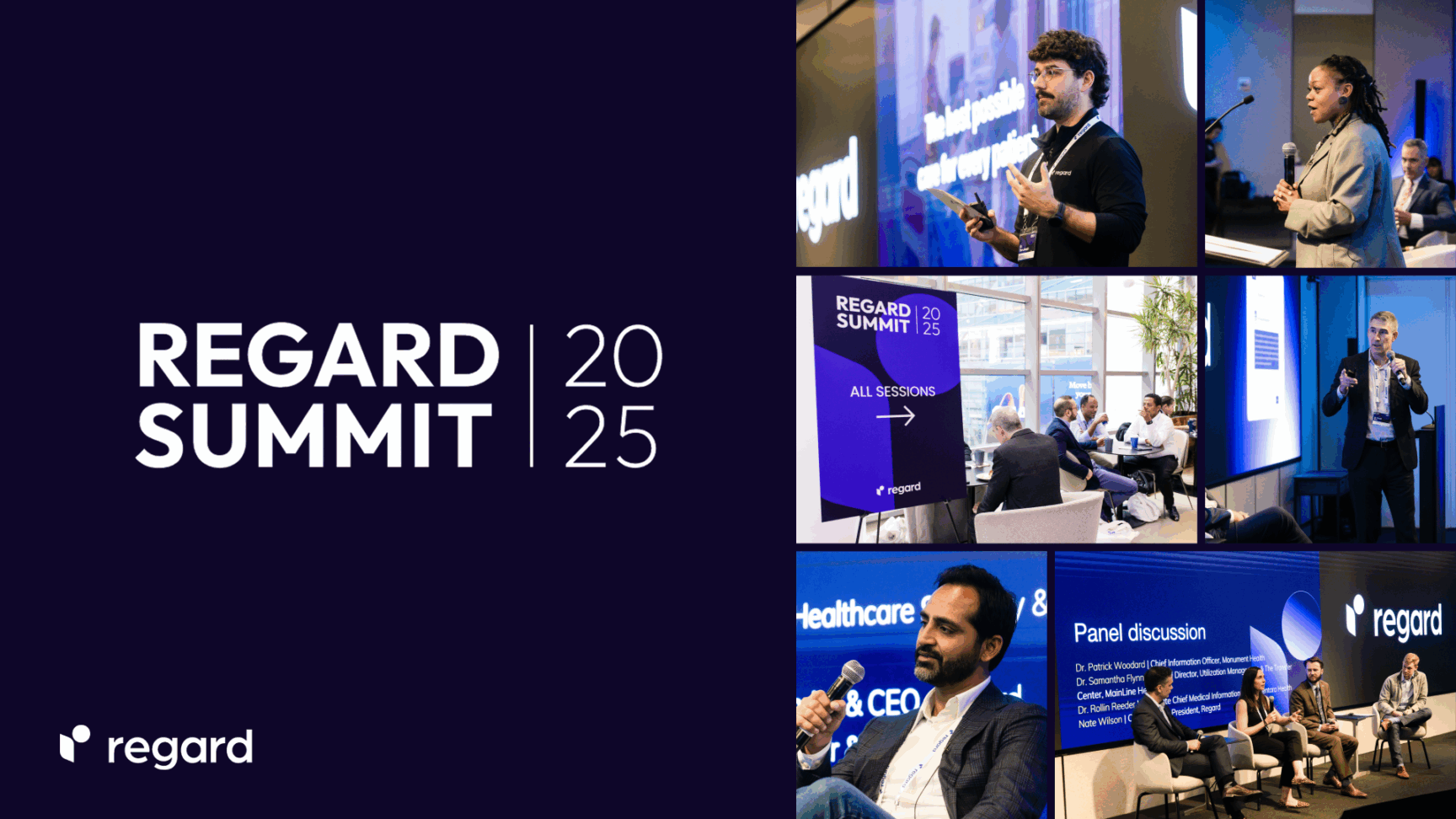
Regard’s CEO, Eli Ben-Joseph, opened the 2025 Regard Summit with this question, framing the event and a powerful analogy for what clinicians face every day.
In an era where electronic health records hold more data than ever before, one might assume all this data would propel patient care forward, allowing clinicians full visibility into a patient’s history. In reality, most physicians can feasibly access only 3% of what’s available in a patient’s chart. The rest remains buried and is simply impossible for the clinician to review, when every second counts. This is known as the clinical insights gap – and Regard was built to close it.
Regard’s approach, known as Proactive Documentation, helps clinicians see the whole picture by surfacing diagnostic insights and critical clinical context, ensuring nothing is missed and generating complete documentation at the point of care. As mentioned in Eli’s opening session, this is about returning to ‘first principles’ and leveraging data to create value for the clinician.
The 2025 Regard Summit focused on helping healthcare’s pilots ensure they have everything they need to navigate the often stormy skies of medicine.
A collective vision for better care
The Regard Summit gathered clinicians, executives, and innovators from across the healthcare landscape, united by the belief that technology can make healthcare more human when it’s built with clinicians, not just for them.
Regard’s Co-Founder and President, Nate Wilson, kicked off the agenda with a session titled Reactive to Proactive, where he stated that the shift isn’t just technical; it’s redefining how clinicians work. “If we can proactively review all of that data and recommend a diagnosis, you can change the whole paradigm… it has to be accurate, it has to be trustworthy, it has to be auditable.”
Dr. Rollin Reeder, Associate CMIO at Sentara Health, also remarked during the same discussion, “Our notes are no longer a reflection of who we are, and that’s at the root of the problem.”
At the heart of these conversations was a new way of thinking about care and clinical documentation. Traditionally, clinical notes are written and reviewed after care is delivered, making the process reactive, fragmented, and often burdensome. Regard’s emphasis on Proactive Documentation flips this model. By analyzing all available patient data in real time, Regard surfaces potential diagnoses and relevant evidence before the clinician starts documenting. The result is more confident care and more accurate documentation.
The tone throughout the structured sessions and spontaneous hallway conversations was collaborative and personal. Attendees compared how they’re using Regard to improve both patient outcomes and documentation experience, and shared how it’s impacted their practices and lives.
Attendees also joined small-group roundtables and advisory workshops to shape the next phase of Regard’s roadmap. The energy was constructive, even urgent. Leaders spoke not about features but about culture, emphasizing the need to rebuild trust in technology in modern healthcare and restore the sense of purpose that inspired so many to become clinicians.
As Eli Ben-Joseph noted during his keynote, “Adoption moves at the pace of trust.”
Proof in practice
Health system leaders shared their implementation journey and results from using Regard, including compelling impacts on both care and revenue integrity.
- WakeMed reported a 10-point increase in Case Mix Index (CMI) and a projected annual reimbursement impact of more than $4 million from three hospitals. But even more importantly, they saw a 20%-30% improvement in O/E Mortality in critical areas like stroke and sepsis.
- White Plains Hospital used Regard to streamline documentation and ensure that clinicians captured every critical detail. The result was higher CMI and CC/MCC capture rates and documentation that more accurately reflected the complexity of patient care.
In the Making it Real session, Dr. Mary Weitzel, Chief of Acute Care Services at FirstHealth of the Carolinas, shared, “It’s taken away some of the burden of ‘I have to remember to document this, that, and everything else.’ Our providers have time to round again, to connect, to care.”
The stories made it clear that success lies in treating these as large-scale transformations rather than merely implementing a technology. Clinical leaders emphasized the importance of change management and incentives to encourage adoption, at-the-elbow training, and clear ROI metrics to ensure scaling and network effects.
Shared stories of better care
The session that resonated most deeply with all was the emotional “Stories with Regard” panel, where physicians who use Regard in their practices spoke about its clinical guidance and patient impact.
Dr. Francisco Alvarez shared a notable moment that brought the idea of Proactive Documentation to life. A patient who had recently undergone a stent placement was admitted for a stroke. Regard flagged that their Plavix prescription had been accidentally held during a handoff, which is a small but potentially devastating oversight.
“[Regard] is like having a second pair of eyes watching over your patients.”
Dr. David Kirk offered another striking perspective, describing how Regard’s AI agent, Max, had a significant impact on the journey and outcome for his patient in the ICU.
“Four questions for Max, and I knew almost everything I needed to take care of this patient. In the chaos of a rapid response, that information saved her life.”
These moments captured what proactive documentation really means. It isn’t about replacing physicians or automating their work; instead, it empowers them with the clarity and confidence they need, and when their patients need it most. Regard ensures that medicine’s priorities remain rooted in human insight and judgment, and while AI can support the process, wisdom will always belong to the clinician.
During the “Regard Reveal” roadmap session, Director of Product, Danny Tryon, outlined upcoming advancements focused on transparency and auditability. Clinicians will soon be able to see more of how Regard’s AI reaches its conclusions, including what data was used, what evidence supports it, and how each suggestion fits into their workflow, unveiling the magic behind “Max.”
Coming Full Circle
From the doctor’s bag of the 1930s to today’s AI-powered platforms, medicine has come full circle. Early physicians cared through presence and intuition, and now, Regard’s proactive documentation makes it possible to bring that focus back.
By transforming scattered volumes of data into precise, timely insight, Regard helps clinicians rise above the noise and ascend from information to wisdom. The 2025 Regard Summit showed that the future of medicine is within sight.