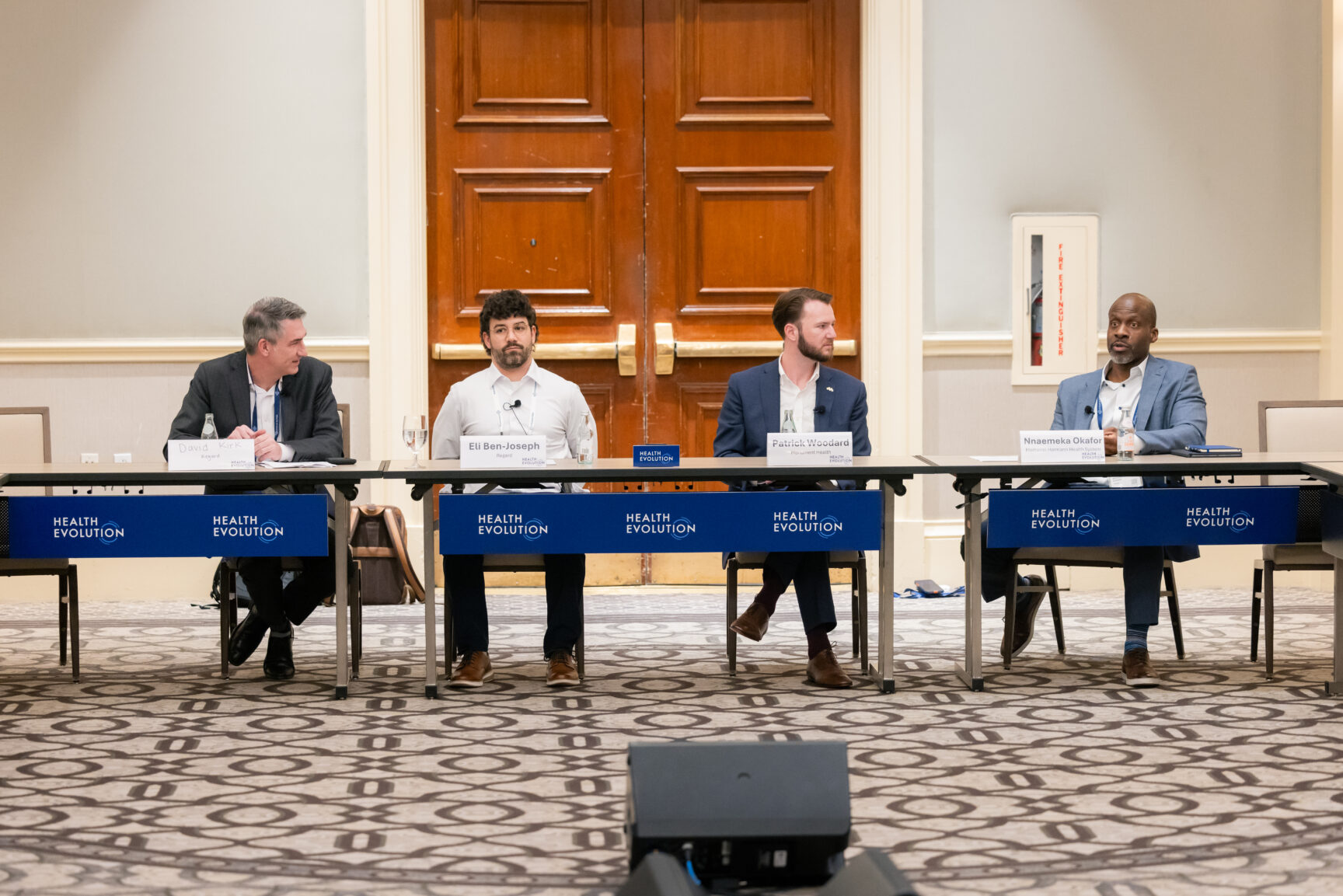
At Health Evolution Summit in Dana Point, California (April 21–23), Eli Ben-Joseph, CEO and co-founder of Regard, joined Dr. Nnaemeka Okafor, VP and Chief Informatics and Analytics Officer at Memorial Hermann, and Dr. Patrick Woodard, Chief Information Officer at Monument Health, for a Brass Tacks breakout session on proactive documentation and the future of clinical AI. Dr. David Kirk, CMO of Regard, moderated.
Key takeaways
- Documentation, quality, and revenue are all downstream of the same problem: diagnoses missed at the point of care. Fixing that upstream fixes everything else.
- Ambient tools are now table stakes. The untapped value is in the chart data that still goes largely unread at the moment it matters most.
- Every CDI query is a failure. What doesn’t get recognized at the bedside becomes a query, a denial, or missed revenue, and what gets recovered retrospectively is a fraction of what was lost.
- The clinical case and the financial case are the same argument. Health systems that measure them separately are solving for the wrong thing.
The data problem is a diagnosis problem
Ambient documentation tools changed what was possible for clinicians. Two years ago, deploying ambient was a differentiator. Today, as Dr. Woodard put it, “it’s kind of table stakes,” a baseline expectation and increasingly a recruiting tool rather than a competitive advantage. Ambient moved the needle on physician experience but drew from a narrow slice of what’s in the chart. The data sitting in the EHR, labs, notes, histories, medications, prior encounters, remains largely unread at the moment it matters most. As Ben-Joseph framed it, “scribe mania is kind of coming to an end. Health systems are starting to see more and more that there’s so much potential in that data.”
The challenge for Memorial Hermann and Monument Health isn’t missing data, but rather an excess of data. Dr. Okafor described what the Epic migration revealed for his emergency physicians: “My physicians aren’t saying, ‘I don’t have the information I need.’ It is, ‘I am overwhelmed with all the information.'” The challenge shifted from gaining access to finding relevant information.
Passing an entire patient chart into a language model produces noisy, unreliable outputs, not because the model is inadequate, but because the data hasn’t been organized in a way that makes it useful. As Ben-Joseph put it: “There’s just so much noise in there that it’s important to clean that layer up, and that cleaning work is incredibly complicated.” Structuring the data correctly is what makes it possible to catch the diagnoses a clinician would otherwise miss, and what separates AI that actually changes care from AI that summarizes what’s already documented.
Every query is a failure
Dr. Woodard was blunt about how the current system came to be. Hospitalists regularly carrying 28 to 32 patients in a day don’t skip intubations, but they do skip documentation. To make up for that, the system built an entire infrastructure on the back end to re cover what was missed. He likened it to taking off in a plane with a door that doesn’t fully latch: “That’s kind of how we do our documentation today. We kind of just take off and hope that the door doesn’t fly open. And then it does. And then that’s like 13 CDI queries asking your doctor, ‘What did you really mean when you said this patient may have been septic?'”
Dr. Kirk named what’s lost in that cycle: “Every query is a failure.” A diagnosis recommendation that reaches a physician as they’re writing the note has a chance of being accurate. One that arrives as a CDI query days or weeks later requires reconstructing an encounter from memory, and the further from the bedside that reconstruction happens, the less defensible it is with payers. What doesn’t get recognized at the point of care becomes a query, a denial, or missed revenue. Getting it right upfront doesn’t just reduce rework, it also produces a more accurate clinical record and better care for the next clinician who picks up that patient.
Adoption is earned, not mandated
Both health system leaders rejected the idea that physicians resist change. What they resist is being changed without input. Dr. Okafor’s operating principle at Memorial Hermann is “We do it with the doctors, not for the doctors — otherwise they’re going to feel like we did it to the doctors.” That means bringing clinicians in at the start, co-designing solutions, and building champions who can translate the problem into terms colleagues understand and care about.
Dr. Woodard framed the same idea from the CIO’s chair: asking busy physicians to prioritize documentation over patient care historically has not gone over well. Tools that help clinicians document better without making them think differently about documentation are the ones that actually get used. “Technologies don’t live and die by the IT teams putting them in. They live and die by the adoption of the tools.”
Both panelists acknowledged that not every physician adopts, and that conversation goes better when the tool was built with clinicians rather than imposed on them.
The ROI case and the clinical case are the same
When Dr. Kirk asked what metrics Monument Health watches most closely, Dr. Woodard pointed to DRG mix and case mix index, “things that are directly impacted not by the care that you actually render, but by how you document that care.” But he pushed back on treating ROI as the only measure. Recruiting a new physician costs roughly a million dollars in soft money that never appears on a balance line, and the value of retaining physicians who are well-supported and not drowning in documentation burden is real, even when it doesn’t show up in a proforma. “If you have a strong value of investment and you’re able to additionally achieve an ROI, now everybody’s happy, and that’s not something that you get to do very often.”
Dr. Okafor mapped the five key areas impacted: revenue protection, quality and patient safety, staff satisfaction, consumer access, and resource management. Each one moves when documentation gets better at the point of care, in the form of fewer CDI staff chasing queries, better Vizient scores, and less time physicians spend on notes after hours.
Regard didn’t start as a revenue cycle company. As Ben-Joseph put it: “We started it because we wanted to empower clinicians to do their best work.” Get documentation right at the point of care, with the full picture of the patient, in the clinician’s workflow, and the downstream benefits for coding, billing, and CDI follow. “That’s always been our hypothesis since we started, and it’s been proving true again and again.”
What comes next
In a lightning round to close, the panelists were asked what will feel like obvious infrastructure in two years that’s currently in pilot. Dr. Woodard said clean data. Ben-Joseph said agentic orchestration.
Dr. Okafor’s answer was the most direct summary of where the room landed: “We have less of an excuse now to build it the right way.” The data layer is being solved. The question for health system leaders is whether their investment decisions reflect that, or whether they’re still funding the back end of a problem that can now be solved at the front.