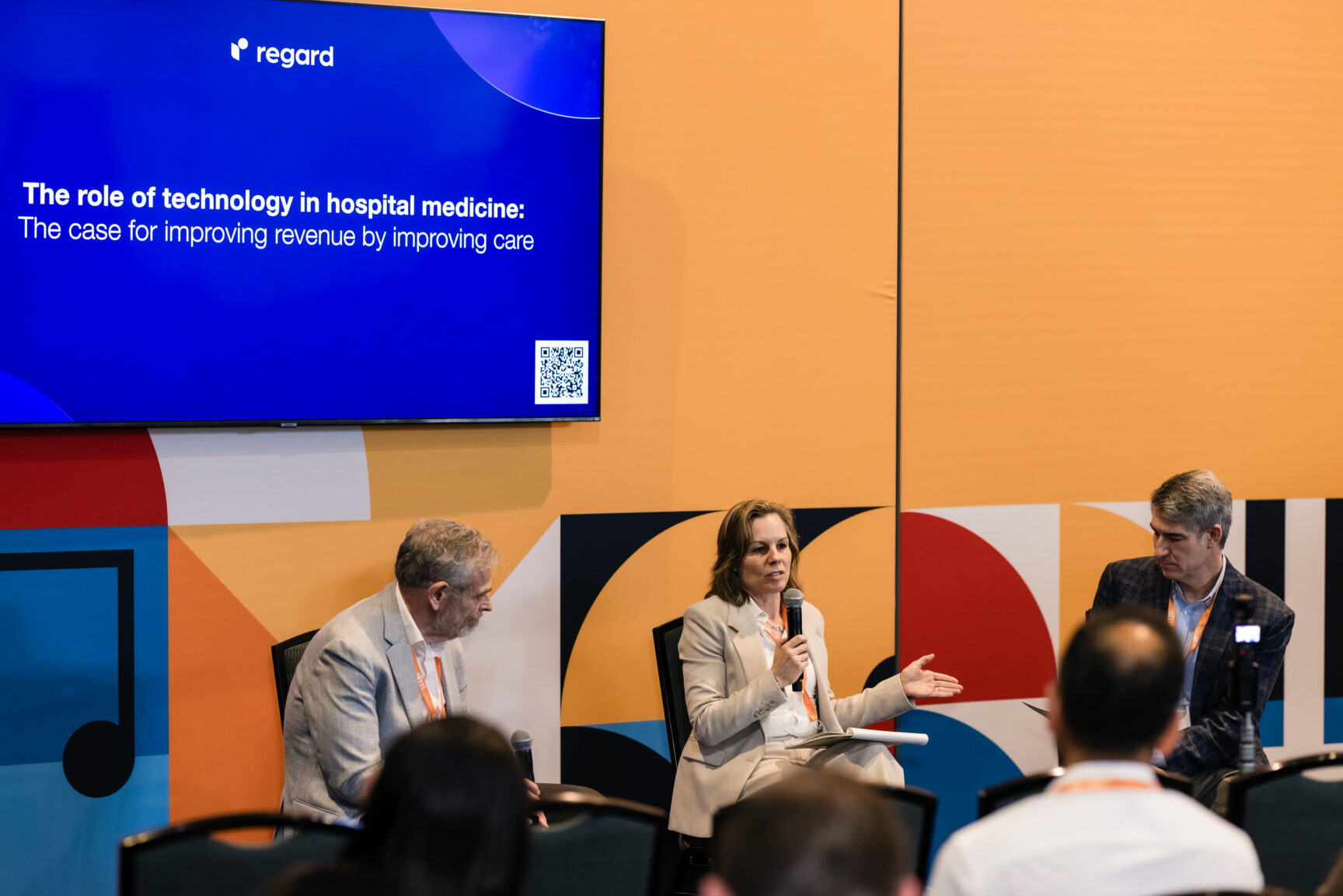
At The Society of Hospital Medicine (SHM) in Nashville (March 29-April 1), Dr. David Kirk, CMO of Regard, moderated a panel on the role of technology in hospital medicine centered around how fixing documentation at the point of care is the most durable path to financial performance. He was joined by Dr. Thomas Fredrickson, System VP for Hospital Medicine Operations at CommonSpirit Health, and Dr. Susan Lee, Physician Executive for Acute Care Medicine at Banner Health.
Key takeaways
- The revenue cycle starts at the bedside. The moment a physician enters a patient’s room is when the case for reimbursement begins. Everything after is rework.
- The CDI business case is bigger than DRG revenue. Mortality, PSIs, risk adjustment, present-on-admission flags, physician retention — these are what CDI teams actually drive.
- Physicians aren’t the barrier to AI adoption. Being left out of the design process is. Health systems that involve physicians in governance and design from the start see fundamentally different results.
- Clinical value and financial return are the same case. Accurate documentation at the point of care drives quality scores, reimbursement, denial rates, and mortality indices. Health systems that treat these as separate problems are solving for the wrong thing.
- Diagnoses missed during the encounter rarely get fully recovered after it. Retrospective queries have a ceiling, and payers are lowering it. Getting documentation right at the point of care is the only durable fix.
The money is already being earned, but it’s not being captured
Most of what’s in a patient chart never gets read. There are simply too many data points and not enough time. Missed diagnoses are a product of that reality, and the downstream systems built to recover what’s missed can only ever recover a fraction of it.
Dr. Kirk opened with a dynamic the room knew well: years of investment poured into the back end of revenue, resulting in retrospective queries, CDI teams chasing documentation after discharge, and coding teams working what’s left. Dr. Fredrickson was direct about where revenue capture actually begins: “The revenue cycle starts the minute we enter the room and see what’s actually going on with the patient.” When revenue capture is treated as a post-encounter activity, the diagnoses that should have been documented during the encounter become queries, denials, and missed reimbursement, problems that compound the further they get from the point of care.
Queries carry a cost that rarely surfaces in a business case: the interruptions, the cognitive load, the time spent logging back into charts after a shift ends. Dr. Fredrickson stated it plainly: “The CDI process is almost the definition of rework.” The case for moving upstream is that retrospective recovery has a ceiling, and the window to defend a diagnosis keeps narrowing.
The full CDI business case
The organizations framing CDI as a billing function are measuring the wrong thing. CDI teams are doing more than chasing DRG upgrades. Mortality documentation, PSIs, present-on-admission flags, and risk adjustment variables are what actually move quality performance, and increasingly, what health system leadership is watching most closely. “There’s a shift away from just the DRG revenue,” Dr. Lee said, “because the quality scores are just too important.”
That reframe has a direct effect on physician relationships. When clinicians see CDI as getting them credit for care already delivered, query agreement rates climb and the program stops feeling adversarial. Burnout reduction, retention, and engagement follow — measurable returns that belong in the business case alongside DRG uplift.

Physicians aren’t the barrier
Both panelists rejected the idea that physicians resist technology. Dr. Fredrickson pointed to the EHR: “Who were the champions of the EHR? We were. We made that work.” The panelists pinpointed the disconnect, stating that the resistance isn’t to technology, but rather to tools that are designed without the user in mind.
Dr. Frederickson believes that the answer to overcoming the wariness around technology is to involve physicians in the initial decision, involve them in design, and never mandate use. “Make things so good that they adopt it. If you say you gotta do it — people read through the lines.”
Dr. Lee grounded it in practice. Super users, utilization metrics, and regular town halls all help, but none of it works without the foundation underneath. “If people aren’t communicated with properly, if they don’t really understand what you’re doing, and if it goes too fast — that tends to be a recipe” for failure. Move faster than physician understanding and even a strong tool gets written off before it has a chance to prove its value.
Telling the same story twice
When Dr. Kirk asked whether the pitch to hospitalists and the pitch to CFOs are different conversations, Fredrickson’s answer was no. “Hospitalists resonate with getting time back, with improving quality.” Those things translate directly into fewer denials and better CMI. “It’s the same story — just with a different point of emphasis.”
That reframe has a practical implication for how health systems build the business case. Clinical value and financial return are the same argument. Accurate documentation at the point of care is the input to every downstream output: quality scores, reimbursement, denial rates, mortality indices. Health systems that measure them separately are solving for the wrong thing.

What actually changes
Queries are not going away. Payers delay by design, and the rules governing what documentation holds up keep shifting. But when diagnoses are captured during the encounter, grounded in clinical evidence already in the record, they are defensible in ways that retrospective queries increasingly are not. That shift in defensibility changes the economics substantially, even before query volume meaningfully drops.
The downstream effect reaches clinicians directly. Finishing a shift carrying the fear that something was missed, or that a backlog was left for a colleague, is a product of working through more chart data than any physician can reasonably review in a day. Dr. Kirk was direct about what changes when the full picture is actually seen: “You’re much less likely to miss something important because you’re not manually going through every note.” The promise is finishing the day confident that nothing that needed to be seen went unseen.